Sunday, May 29, 2016

Sandhills and Wind Mills


Over spring break, as some of you may know, I went to Yellowstone National Park. While the park was amazing and an experience that I will never forget, one of my favorite parts of the trip happened a couple of states away in Nebraska. The last day we left Montana so that we could get to Kearney at sunrise. Kearney is on the Platte River and is a very important to a specie of birds. Every year hundreds-of-thousands of sandhill cranes, 80% of the total population, gather on the Platte River on their migration north They were calling constantly; the air was filled with noise. Massive flocks of 4-5 foot birds flew over head, it was amazing. Unfortunately we did not arrive in time to see them dance before they took, off but it was still awesome. Thanks to Dr. Mike Rentz and Dr. Cassandra Nuñez I was able to have this experience and thanks to Dr. Stephen Dinsmore I was awe-inspired. I spent a lot of time looking at the cranes and taking pictures, just ask my fellow students who waited on Dr. Nuñez and I. Seeing the sandhill cranes fly above as pairs or in massive flocks and watching them eat in the corn fields was something I will never forget and something I will definitely go see again.


Sandhill cranes are one of the largest species of birds in North America, with a wingspan over 5 feet wide. They are usually have gray plumage but will rub red dirt into their feathers and gain a reddish hue. They also have a red forehead and white cheeks. Sandhill cranes will eat whatever is available, from plant matter to invertebrates and small mammals. There are six subspecies of sandhill cranes and they live as far south as Cuba and all the way up to eastern Siberia. Sandhill cranes are also possibly one of the oldest still living specie of bird with a fossil in Nebraska found that is an estimated 2.6-5.3 million year old. Sandhill cranes can live up to twenty years and will mate for life.


Many believe that windmills hurt birds, but a recent United State Geological Survey paper tells the opposite. Sandhill cranes over-winter in the central and southern Great Plains, an area that contains many wind turbines. The USGS looked at sites where the cranes wintered in the past and current sites of wind turbines. They tracked some cranes using GPS to monitor their locations. They found that there may be some slight evidence of tagged cranes avoiding windmills when they tended to avoid areas with windmills. They countered that this may be due to location of suitable habitats rather than avoiding the turbines. The major finding was that the past winter range of the sandhill cranes only overlapped the current areas with windmills by 7%. This number is low and means that the turbines are not directly affecting the cranes. A major threat to sandhill cranes is removal of suitable habitat, namely wetland. Wetland preservation is what is important to help this species.

Sandhill cranes are amazing animals and are a fantastic sight that I hope everyone gets the chance to observe.


Articles

Cranes vs Windmills

USGS Crane Study

Sandhill Cranes


Saving Cranes

Picture

All by Justin Hohlen


Wednesday, May 25, 2016

Wildlife Wednesday: Bowerbirds


Bowerbirds are unique avians found in Papua New Guinea and Australia. There are 20 species total with ten found in Papua New Guinea, eight found in Australia, and two found in both. They live in a variety of habitats from dense rainforest to eucalyptus forests. These birds feed on many different items including: insects, fruit, leaves, and nectar.

Maypole Bower

While all of that information was interesting, what bowerbirds are known for are their mating behaviors. There are four species that are monogamous. Those are cool, but the fascinating species are polygynous, meaning males mate with as many females as they can. These males also build some of the most fascinating structure created by an animal. the bowers. Male bowerbirds will spend months collecting anything from twigs and leaves to bottle caps and shells to add to their bower to make females like it. Males will create the bowers and then lay their items around the bower hoping to attract a mate. There are two kinds of bowers, the maypole and the avenue. A maypole bower is a structure that is centered around a sapling and then all the twigs are laid against it to make a hut of sorts. The avenue bower is a walled path that the male created and then he may paint the inside with juices.


Avenue Bower

Bowerbirds are fascinating animals and if pictures are not enough for you then check out these videos and learn from National Geographic and the fantastic David Attenborough.


Articles


Saturday, May 21, 2016

British Beavers


When people from North America think about beavers they are generally thinking about North American beavers (Castor canadensis), but there is another species of beaver that is native to Europe and parts of Asia, the Eurasian beaver. Eurasian beavers are a topic of debate in the United Kingdom. Many want to reintroduce the species but there is also a lot of people against it.

Eurasian beavers do not grow as large as their North American counterparts and are a rare example in mammals where females may actually grow larger than males of the same size. They are also Europe's largest native rodent. Eurasian beavers have been extinct in the wild for hundreds of years in Britain with some of the last populations found in Scotland in the 1800's. Beavers were hunted for their pelts as well as their castor glands that produce castoreum. Castoreum is a secretion that the beavers use in scent marking but humans decided to use it in medicine to relief headaches. It has also been noted that Eurasian beavers are less aggressive and build fewer dams and build them in shallower water than their North American relatives.


Eurasian beavers have been kept on private lands for a number of years, but the first reintroduction by a government agency started in 2009 when the Scottish government released 16 beavers in four family groups into Knapdale Forest. Several private trusts and foundations have established areas that they release beavers into including areas near Devon and the Cotswold Water Park. Wild sightings of beaver have also been spotted near Devon and it was determined that they had not escaped from the nearby enclosure and had successfully reproduced. There is also a population in Scotland at Tayside and it is believed that these beavers came from private collections. In all of these areas beavers are currently being allowed to remain by government agencies and are monitored to see their impacts.

There have been positive and negative impacts of the beavers. It has been found that beavers have had a great impact on the local environments. The dams they create act to slow down rivers and mitigate local flooding. Slowing down the rivers also reduces erosion. The beavers have also increased local species by providing more suitable habitat for otters, dragonflies, waterfowl, other birds, and amphibians. Beavers also increase plant biodiversity by removing trees and flower will grow their inviting insects.They also stimulate more tree growth when they remove some of them. By increasing wetland areas the wetlands are able to filter out more pollutants as well as decrease the amount of silt moving down river.

Stock Photo: Eurasian beaver suckling three cubs / castor fiber.

The beaver also worries people about having negative impacts. One group of people that have concerns are the farmers. The farmers are worried that the dens in the banks of the rivers will cause the ground under their farms to collapse and they are worried that the beaver dams will flood their fields. It should be remembered that these beavers build dams more infrequently than what is thought. Farmers are also worried about disease transmission to their livestock, but none has been found thus far. The anglers of Britain are also worried about the impacts of beaver on migrations of salmon and eel. It has been shown in other European countries where these animals all coexist that the beavers do not hurt fish migrations and actually help them by providing more safe spawning areas. Their is also a misconception that beaver eat fish, but this is not true.

I believe that their has been sufficient evidence to show that beavers can thrive in Britain if they are given some initial protections and allowed to remain. I think reintroduction of an extirpated species is a great idea and we should try to do what we can to restore environment to a balanced setting.

Eurasian Beaver Diversity In Question

Articles


Pictures


Wednesday, May 18, 2016

Endangered Species Day


Today is Endangered Species Day. In honor of this I am launching a new series on the blog and joining others by participating in Wildlife Wednesdays. Every Wednesday I will be doing a wildlife spotlight. This spotlight will be a brief overview of the animal. Since today is Endangered Species Day I will be spotlighting an endangered animal.


Today's Wildlife Wednseday is about the Amur leopard. The Amur leopard is an extremely rare subspecies of leopard that lives only in eastern Russia; they also once lived in Korea and northern China where they are now extinct. It is estimated that only about 20-40 adult leopards exist in the wild. Amur leopards are listed as critically endangered. Amur leopards have long hair that is especially thick during the winter. They feed mostly on hares, roe and sika deer, badgers, ad raccoon dogs. They are also phenomenally athletic with top speeds of 37 mph and the ability to jump 19 feet horizontally and 10 feet vertically. While Amur leopards are generally solitary animals it has been observed that some males will stay with the females after mating and may even help raise the young. They will also move and hide their kills so that other animals do not steal them. Amur leopards may live up to 15 years in the wild

While there are about 150 supposedly Amur leopards in captivity, they suffer from inbreeding and breeding animals of unknown pasts together. Due this only about 12 contain pure genetics. This is also a problem faced by wild populations which have low reproduction rates and low genetic diversity.


These animals face habitat loss from logging, road building, and encroaching civilization. People also poach these animals for many body parts that are used in traditional eastern medicine. Global climate change is also an issue as these animals can not with stand the increased temperatures. Amur leopards also face a different threat from humans, being ignored. While a lot of money and publicity has gone toward saving Amur tigers, very little attention has gone to Amur leopards.


Articles

Endangered Species Day

WWF: Amur Leopard

Amur Leopard

All About Wildlife: Amur Leopard

Pictures

Leopard Staring

Leopard in Snow

Leopard Laying: Justin Hohlen

Tuesday, May 17, 2016

Saiga Saga

                                                               
Well to begin with I must make a confession. While this post may be about saiga antelope it is not really a saga, even though it makes a catchy title. While this is not a saga it is a fascinating and mysterious situation. Saiga antelope are an interesting and ancient species that currently face threats of human and microscopic origins.

Saiga antelope are a unique speceis that are recognizable due to their bulbous nose, spiral horns, and chestnut-colored pelts. Saiga have been around since the Ice Age and once roamed the steppes and tundra with wooly mammoths and saber-toothed tigers. They have been found in the fossil record ranging from Europe to Alaska. Currently saiga atelope are only found in central Asia in countries such as Russia, Turkmenistan, and Uzebekistan but the majority of individuals are located in Mongolia and Kazakhstan. While there exist two subspecies of saiga they are look very similar and are distinguished only by genetics and location. The unique nose of the saiga antelope is functional because they can move and inflate it to breathe clean air in the dusty summers and  warm air during cold winters. The pelt of the saiga changes with the seasons; in the summer it is thin with the chestnut color and in the winter the coat is thick and white. Saiga participate in one of the largest migrations on Earth where tens of thousands of saiga form herds.


While saiga antelope are fascinating and look like nothing else, they face great threats from humans and disease.  There have been people who poach saiga for their pelt and horns. It is believed that saiga horns have medicinal uses in traditional eastern medicine. Saiga have also lost habitat to farming. One of the greatest problems facing saiga antelope is a bacterial infection that has high mortality. In the 1990's there were over a million saiga in the wild and now it is around 50,000. One key aspect that is killing these animals is this bacterial infection. Last year the bacteria killed 120,000 individuals. The bacteria has been determined to be Pasturella. Pasturella is usually found in cattle, bison, and buffalo but have a much lower mortality rate in those animals. Pasturella causes the animals to hemorrhage. The disease has symptoms such as depression, diarrhea, and frothing at the mouth. Within a couple of hours of showing signs of disease the animals die. The disease is usually most prevalent when females gather to birth. This is when the females and calves usually become infected and die.

The government of Kazakhstan had been working hard to find the cause of the disease and had hired veterinarians from Europe to work on it. They have also been enforcing poaching laws more heavily. Saiga are an important species for the steppe landscape and are a unique species.


Articles

Mass Deaths of Saiga

WWF Saiga Antelope Description

FWS Saiga Description

Mysterious Die-off

Saiga Antelope Death Toll Reaches 85,000 

Scientists Probe Mysterious Wave of Antelope Deaths

Saiga Mysteriously Die-off

Ministry of Agriculture Continues to Relict Animal Protection

Kazakhstan Government


Pictures

Male, Female, Calf

Herd

Dead Pile

Friday, April 29, 2016

These trout are cutthroat


Yellowstone National Park was the first of its kind anywhere in the world. Established in 1872 with the goal of preserving part of the American west for future generation, Yellowstone has undergone many changes in its years: there was the return of bison, eradication and then return of wolves and cougars, and the change of mindset from entertainment to preservation and education. These grand and majestic changes are fascinating and interesting to learn about, but our story today is about a humble fish. Today I will talk about cutthroat trout, one of only 11 species of fish native to the Park. There are two subspecies of cutthroat trout: Yellowstone Cutthroat Trout and Westslope Cutthroat Trout. Cutthroat trout face a couple of issues in Yellowstone, predation from introduced fish species and introduced diseases. This is a not good as cutthroat trout are extremely important in the Yellowstone ecosystem. Let's talk about their role in the ecosystem, threats to them, and what is being done to help preserve cutthroat trout.

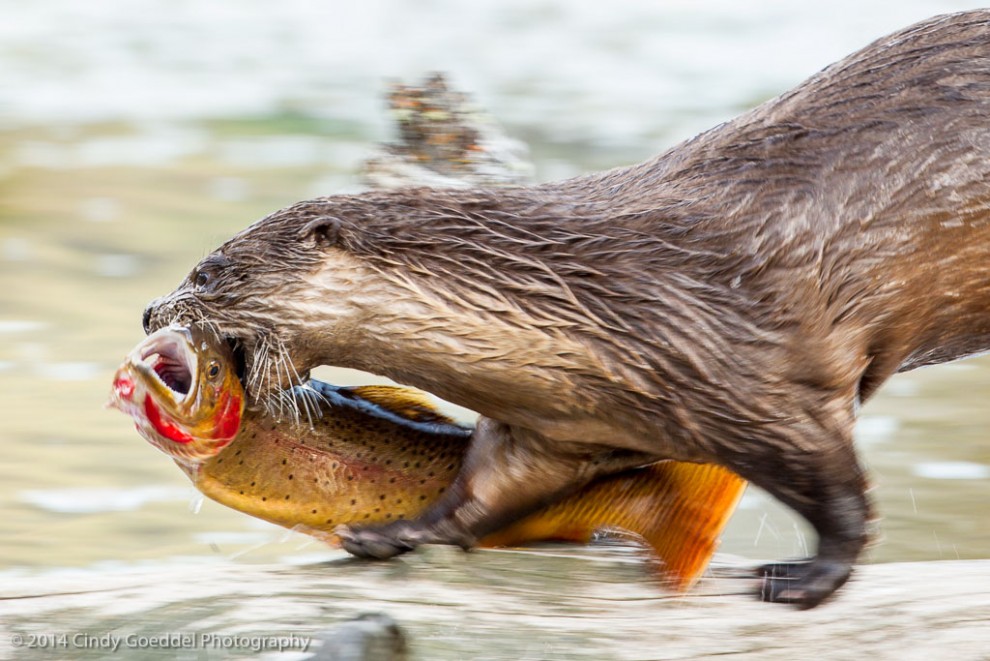
Cutthroat trout are an important species in the Greater Yellowstone Ecosystem. They are an essential prey item for many species including bears, otters, and osprey. Cutthroat trout are easily digested and have a lot of protein and fats making them one of the best energy sources for bears. These trout are needed for bears in early spring and summer to help regain body weight that was lost over the winter and help mother have enough energy to produce milk for her cubs. At these times cutthroat trout are swimming upstream from lake large rivers or lakes to shallow streams, where they breed. During these months bears wade into the streams and catch trout which can be a main source of food for many bears. The levels of trout are very important as a high-quality food-source. A decrease in high-quality food-sources can lead to the Park supporting lower bear populations. The spawning time of cutthroat trout is also important for river otters. The small young of the cutthroat are easy to catch for otters and adult cutthroat trout are great energy sources. Osprey depend on cutthroat trout as a major food source. Osprey are birds of prey that feed mostly on aquatic animals. Osprey can dive up to about 3 feet into the water and cutthroat rout usually do not swim much deeper than 3 feet. Cutthroat trout have been an important source of food for many animals for a long time and play an key ecological role.

[​IMG]

Several items currently threaten cutthroat trout in Yellowstone National Park. A less substantial threat to cutthroat trout is hybridization of the two subspecies. The two subspecies are close enough related that they can breed. This leads to impure genetics and the combining of the two subspecies. Before Euro-americans arrived in Yellowstone and the United States began implementing management techniques to help save cutthroat trout in general, the two species would have been divided by geographic boundaries such as waterfalls and rivers that did not connect. In some areas this hybridization is natural. Another issue that is harming lake trout populations is whirling disease. Whirling disease is caused by a microscopic parasite that can infect the trout, but does not harm humans. the parasite will usually infect young trout and it will feed on their cartilage. This causes skeletal deformities, a blackened tail, and poor swimming abilities. This leads to fish being unable to feed normally and they are more likely to be caught and eaten by a predator. It is estimated to infect about 20% of the cutthroat trout in Yellowstone Lake and it has been shown in laboratory tests that cutthroat trout can readily get whirling disease. While cutthroat rout can get whirling disease lake trout cannot and they are a main predator of cutthroat in lakes. Scientists believe the parasite came from Europe via frozen fish products. Currently no treatment is available that could effectively stop  the spread of whirling disease. By far the greatest threat to cutthroat trout are lake trout. Lake trout were introduced to Lewis and Shoshone lakes, two fishless lakes, during the 1890's when the park put fish into the lakes for sport fishing. It is believed that someone transported illegally to Yellowstone Lake, either accidentally on purpose, in the 1890' and 1990's with the first confirmed catch in 1994. Lake trout do not fill the same role as cutthroat in the ecosystem. Lake trout grow much larger than cutthroat and an adult lake trout can eat about 41 cutthroat trout each year, about 80% of their diet. Young lake trout will also eat the same food that adult cutthroat trout eat. As lake trout age they go deeper and deeper into the lake. This is a drastic difference than cutthroat that only go to a depth of 3 feet. The large depth at which lake trout can be found means that bears cannot catch them and osprey cannot dive for them. Lake trout also spawn in the lake instead of shallow streams. This means they do not make journeys up river where bears and otters can catch them. Due to the introduction of lake trout the abundance of cutthroat trout at a prominent spawning locale declined from 70,000 in 1978 to 538 in 2007. The lake trout predate on cutthroat trout meaning their is less to breed and make the trek up river. This means less food for other animals and lake trout do not replace them in these behaviors. These are all serious issues that have damaged to number of cutthroat trout in Yellowstone.
Gillnetting effort 'making a dent' in lake trout in Yellowstone Lake
A lot is being done to to reduce the number of lake trout in Yellowstone, but many believe that it will be impossible to completely remove it from the park. Gill-netting has removed over 1.7 million lake trout since 1994 and park visitors catch about 20,000 lake trout every year. This gill-netting has been relatively successful. When you compare levels of lake trout in 1984, 19.1 per net, to 2010 levels, 5.3 per net, to 2013 levels, 13.2 per net, you can see there was a significant decrease and then increase in cutthroat trout abundance. This is a positive sign that management may be working. Park staff have also been working to remove nonnative species from from many waterways throughout the park. There will be a long period of removal before cutthroat are reintroduced. The park has also begun to place barriers in waterways to prevent nonnative species from moving into new areas. Park authorities have also been raising both subspecies of cutthroat so that they may be reintroduced into select areas. The future is still uncertain for cutthroat trout, but things are looking better. The National Park Service has been working hard to keep this species around so that it may continue to fill its niche and exist for the sake of it existing.
Yellowstone Trout

Check out this video about the issues the trout face.

This year is the 100th anniversary of the National Parks Service. Go out and check out a national park and enjoy our beautiful country. Happy Birthday NPS!!

National Park Service Centennial logo


Sites to Check out:

https://www.nps.gov/yell/learn/nature/fishaquaticspecies.htm

https://www.nps.gov/yell/learn/nature/Westslope-Cutthroat-Trout.htm

https://www.nps.gov/yell/learn/nature/whirlingdisease.htm

https://www.nps.gov/yell/learn/photosmultimedia/yellowstone-indepth-episode-2.htm

https://www.nps.gov/yell/learn/nature/lake-trout.htm

https://www.nps.gov/yell/learn/nature/Yellowstone-Cutthroat-Trout.htm

https://www.nps.gov/yell/learn/nature/beartrout.htm

https://en.wikipedia.org/wiki/Gillnetting

Pictures:

http://goeddelphotography.com/uploads/photos/_large/otter-carrying-cutthroat-trout-yellowstone.jpg

http://fisheyeguyphotography.com/wp-content/uploads/2013/11/yellowstone-cutthroat-brook-trout-photo-yellowstone-river.jpg

http://www.thephotoforum.com/threads/tokina-vs-osprey-aka-osprey-gasm.327459/

http://billingsgazette.com/news/state-and-regional/wyoming/a-day-of-gill-netting-makes-a-dent-in-yellowstone/article_72926eaa-8fcb-11df-a76a-001cc4c002e0.html

Friday, April 22, 2016

Beautiful Butterflies


Alright you all have probably been reading about some great birds or mammals in my blog posts but now let's talk about something that is a bit smaller; let's talk about bugs. I don't mean bugs in general I am talking about butterflies, monarch butterflies to be specific. These beautiful orange and black butterflies inhabit large parts of North America in the summer months and during the winter they will migrate to warmer regions such as California and Mexico. In Mexico and California they will breed and spend the winter there and a new generation will fly back to habitats across the United States and Canada that their ancestors once lived where they will breed and then their descendants will fly back to the warmth in the winter and so the cycle continues. It is amazing that monarch butterflies are able to consistently travel to the same spot because they have never been there before in their life. Monarchs will only live for between 6 weeks and 2 months with their butterfly stage lasting from 6 weeks to one month. You may have had six or more generations in a single year and those born in June will not live until October to migrate south and those born in November will never go north. This constant change of individuals is what makes the annual migration of millions of monarchs fascinating. While they may be super cool monarch butterflies are in trouble. The population of monarch butterflies in Mexico for the winter was around 1 billion in the 1990's and last year they determined that the current population only numbered 30 million. This is a decrease of 970 million monarch butterflies in about a 25 year period. The number of monarchs that was lost is almost three times the current population of the United States. There are a few issues that are affecting monarchs, but there are also solutions that are able to be completed by anybody.

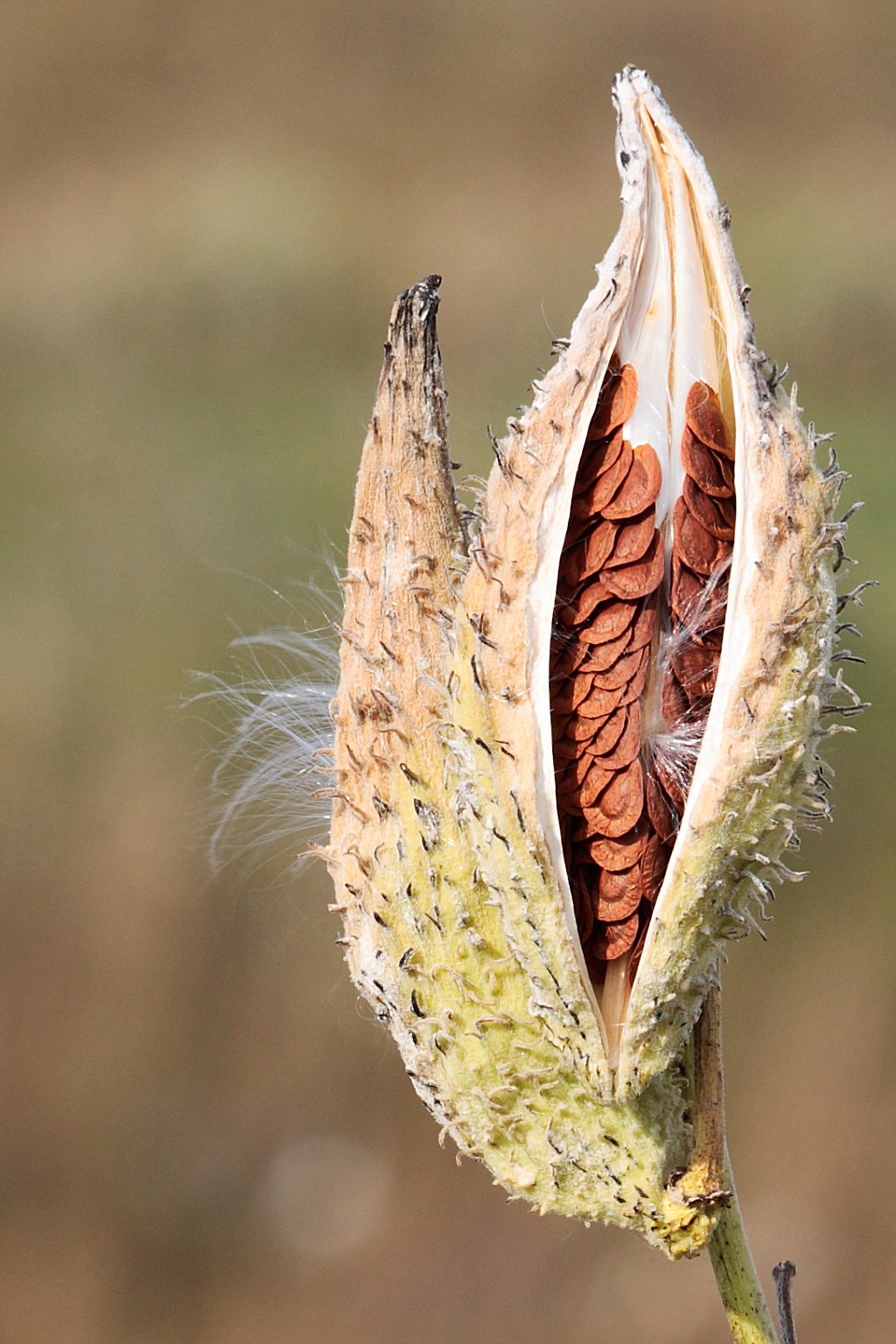
You may be wondering what is causing monarch butterflies to decrease so rapidly in number. One problem the monarchs face is deforestation of their winter homes in Mexico. Research that was conducted by an international team and the Mexican government indicated that a little more than half of what was previously intact forest is still there. This deforestation is happening in areas that are labeled as protected by the Mexican goverment. The problem is that the locals don't see the value of this area in their daily lives. They needs this forested area for fuel for their fires or as timber to sell. The Mexican government suggested expanding the protected area as well as compensating the locals for the income they would lose by not harvesting from the forest. That is what is happening internationally but what about what is happening in your backyard or neighborhood to cause the decline of monarch butterflies. Two issues that are hurting monarchs near you are drought and pesticides. In regions of the western United State recent summers and winters with very little rainfall have hurt populations of monarchs because they have not been able to get enough water into their diets from flowering plants. Pesticides are designed to kill insects that feed on crops and a side effect of this is the death of bees and butterflies who actually help the plants by pollinating them. The greatest threat facing monarch butterflies is the loss of milkweed plants across the continent. Milkweeds are flowering plants that produce seed pods where the flowers were. These seed pods contain many little seeds that are attached to white silky hairs that are scattered by the wind. The plant is so named for the white, sticky sap that it produces. Milkweed has been removed when areas have houses built on them and prairies are turned into cropland. Milkweed is essential to monarchs as species of milkweed are the only type of plants that monarch butterflies lay their eggs on and that the caterpillars feed upon. Without these plants the reproductive cycle of the monarch butterfly is interrupted and they are unable to repopulate areas.


I chose this topic because I found it very interesting and is something I have been involved with personally. When I was younger my family raise two monarch butterflies from their chrysalises and then successfully released them. I also try to manage the prairie behind our house to keep milkweed there. I have seen milkweed plants there continuously since my childhood, but I do hope that we can increase their abundance. You too can help save the monarchs. As a homeowner you can plant flower gardens to attract butterflies and feed them. To help monarchs specifically make sure you plant milkweed to feed the caterpillars and give the females a place to lay their eggs. Milkweed plants can also feed adults with nectar. If you are going to plant a butterfly garden make sure you use plants native to your area as they are most beneficial for insects and the ecosystem around your house. Many wonder why it is so important that we save a species of butterfly and I believe Dr. Lincoln Brower said it best when a reporter asked him "What difference does it make if Monarch butterflies go extinct." Dr. Brower responded with "What difference does it make if the Mona Lisa is destroyed or England's Crown Jewels thrown into the trash?" "Who cares about the Crown Jewels?" he continued. "The fact is people, people do care about them; they line up by the hundreds in London to see them. Why? Because, as with the Mona Lisa, they have been taught that these objects have value, that they are a part of man's cultural heritage. Shouldn't it be the same for natural treasures?"


Articles

http://www.kpbs.org/news/2015/apr/15/monarch-butterflies-crisis-west-coast/

http://www.savethepinebush.org/News/OctNov00/Monarch.html

http://www.cbsnews.com/news/monarch-butterflies-face-population-crisis/

http://landscaping.about.com/od/wildflowers/p/milk_weed.htm

Pictures

http://weedpatchgazette.com/wp-content/uploads/2013/08/Common-milkweed-7-3-2013-5-37-09-PM-3240x4320-7-3-2013-5-37-010-768x1024.jpg

https://upload.wikimedia.org/wikipedia/commons/3/35/Milkweed-in-seed.jpg

https://upload.wikimedia.org/wikipedia/commons/6/63/Monarch_In_May.jpg

https://upload.wikimedia.org/wikipedia/commons/0/0c/Monarch_Butterfly_Danaus_plexippus_Caterpillar_2000px.jpg